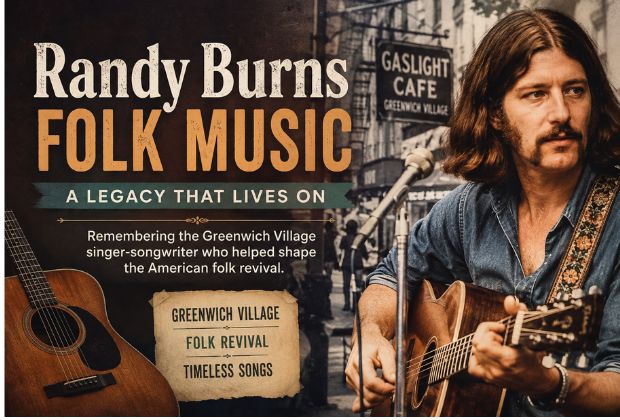
Randy Burns folk music fans are remembering an artist whose career was deeply connected to the American folk revival of the 1960s. Burns, a Connecticut-born singer, songwriter and guitarist who became part of New York City’s Greenwich Village music scene, died Aug. 8, 2026, in Melbourne, Florida, at age 78. His sister, Sue Burns Baker, announced his death, according to the New Haven Register.
For listeners discovering his music today, Burns represents a fascinating chapter in American folk history. He performed in legendary coffeehouses, shared stages with major folk artists and created records that later became prized by fans of folk-rock and psychedelic folk.
Q.Why Randy Burns Folk Music Is Trending
News of Burns’ death has brought renewed attention to a musician whose work never became a mainstream commercial sensation but earned a devoted following over the decades.
His story began in Connecticut. He taught himself guitar as a teenager and started performing at New Haven’s Exit Coffeehouse. In 1966, he left high school and headed to Greenwich Village, where the folk revival was flourishing.
There, Burns performed at venues including the Gaslight Café, Gerdes Folk City and the Bitter End. He also appeared alongside artists such as Phil Ochs, Tom Paxton, Dave Van Ronk and John Hammond.
From New Haven to Greenwich Village
The Greenwich Village scene became a major turning point in Burns’ career.
At the Gaslight, he eventually became a regular opening act, giving the young songwriter an opportunity to perform for audiences who were already following the country’s growing folk movement. His early years were shaped by acoustic performance, personal songwriting and the intimate atmosphere of New York’s coffeehouse culture.
Burns’ first album, Of Love and War, arrived through ESP-Disk in the mid-1960s. He followed it with Evening of the Magician and Song for an Uncertain Lady. His music gradually moved beyond traditional acoustic folk toward a more personal folk-rock sound.
The Sound of Randy Burns
One reason Randy Burns folk music remains interesting is the way his sound changed throughout his career.
Evening of the Magician, released in 1968, featured the Sky Dog Band and incorporated lightly psychedelic elements into Burns’ songwriting. AllMusic describes the record as gentle, personal folk-rock, with Burns’ emotionally focused songs at the center.
By Song for an Uncertain Lady in 1970, his music had developed further into folk-rock, while still retaining the intimacy of his earlier work. The songs often explored relationships, uncertainty and the complicated emotions of everyday life.
Burns later formed Randy Burns and the Sky Dog Band, releasing a self-titled album on Mercury Records in 1971 before subsequent work with Polydor. The group toured extensively and appeared at important venues around the United States.
A Career That Outlasted the Folk Revival
When the commercial folk revival faded, Burns did not simply walk away from music.
He spent time performing in Ireland and later returned to New England, where he became a familiar figure in the Connecticut music community. He eventually resumed recording, releasing The Simple Things in 2008 and Hobos and Kings in 2010.
Burns also reunited with former musical collaborators for performances, allowing longtime fans to reconnect with the music of his earlier years.
His longtime colleague Mat Kastner remembered him as a talented singer, songwriter and performer who brought emotion, concentration and humor to the stage while helping younger musicians along the way.
A Lasting Folk Music Legacy
Burns may not have reached the commercial heights of some of his contemporaries, but that does not make his contribution insignificant.
His recordings capture the atmosphere of a changing American music scene, from intimate Greenwich Village coffeehouses to the emerging folk-rock movement. His work also connects several generations of listeners who continue to explore overlooked artists from the era.
For today’s listeners, albums such as Of Love and War and Evening of the Magician offer a window into the creative freedom and experimentation that surrounded the 1960s folk revival.
A Fan’s Reflection
The story of Randy Burns folk music is ultimately about more than a collection of albums. It is the story of an artist who followed music wherever it took him, from a teenager with a guitar in Connecticut to the coffeehouses of Greenwich Village and stages across America.
Burns leaves behind recordings, collaborations and memories that can continue to introduce his music to new audiences. His passing may close one chapter, but the songs created during his long journey remain part of the American folk tradition—and that is a legacy worth remembering.